Gold Disco Ball Digital Assets: A Practical Guide to Vector Formats and Creative Applications
The resurgence of retro aesthetics in modern design has brought the Gold Disco Ball back into the spotlight. Whether you are a graphic designer working on a brand identity, a crafter creating handmade stationery, or a digital artist developing web elements, understanding the technical specifications of these assets is crucial for professional results. Unlike generic clipart found on free stock sites, premium digital graphics designed with precision offer versatility that scales from business cards to large-format wall art.
This guide explores the distinct advantages of using vector-based Gold Disco Ball illustrations, specifically those created in Adobe Illustrator with an artboard size of 12 x 12 inches at 300 DPI in RGB color palette. We will examine how these files compare to standard raster images, discuss the practical implications of file formats like SVG, JPG, and PNG, and help you determine when this specific type of asset is the right choice for your project.
Understanding the Technical Foundation: Vector vs. Raster
When evaluating digital graphics, the distinction between vector and raster formats is the most critical factor. The Gold Disco Ball assets described here are originally made in a vector program, such as Adobe Illustrator. This means the image is constructed using mathematical paths rather than a grid of pixels.
Scalability without Quality Loss
The primary benefit of a vector-based Gold Disco Ball is infinite scalability. You can resize the element from a tiny icon on a website to a massive banner for a party decor installation without any pixelation or blurriness. In contrast, standard raster images (like low-resolution JPEGs) degrade quickly when enlarged. For professionals who need to adapt one design across multiple mediums—such as jewelry packaging and large wall art—vector files provide a future-proof solution.
Resolution and Color Accuracy
While vectors are resolution-independent, the accompanying raster exports (JPG and PNG) provided in these bundles are typically rendered at 300 DPI (dots per inch). This resolution is the industry standard for high-quality printing. The RGB color palette ensures that the gold tones appear vibrant and metallic on screens, which is essential for web design and digital invitations. However, designers should note that if the final output is strictly for offset printing, a conversion to CMYK may be necessary to maintain color fidelity, though RGB serves as an excellent starting point for most digital and home-print applications.
File Formats Explained: Choosing the Right Tool for the Job
A comprehensive digital pack usually includes multiple file formats. Understanding when to use each format can streamline your workflow and improve the quality of your final product.
- SVG (Scalable Vector Graphics): This is the most versatile format for web and modern design software. SVGs are code-based, meaning they load quickly on websites and remain crisp on retina displays. They are ideal for logo design, web icons, and cutting machines used in handmade crafts.
- PNG (Portable Network Graphics): PNG files support transparency, which is vital for layering the Gold Disco Ball over other backgrounds. Use PNGs for digital invitations, social media graphics, and composite images where the background needs to show through.
- JPG (Joint Photographic Experts Group): JPGs are smaller in file size but do not support transparency. They are best suited for photographic prints, email attachments, or situations where file size is a constraint and a solid background is acceptable.
Having access to all three formats ensures that you are not limited by the technical requirements of your chosen platform or printing service.
Comparative Analysis: When to Use Gold Disco Ball Assets
Not every project requires a detailed, vector-based illustration. To make an informed decision, it helps to compare these assets against other common design resources.
Gold Disco Ball vs. Generic Clipart
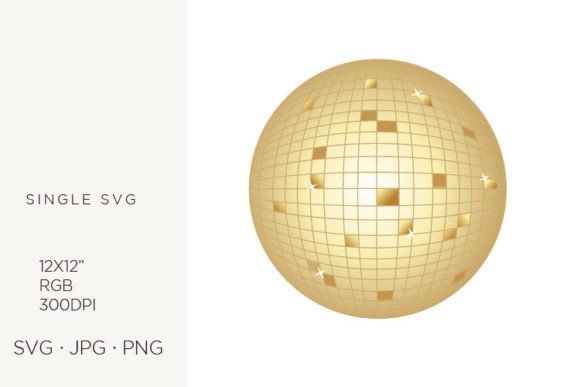
Generic clipart often lacks detail and uses flat, unshaded colors. A professionally crafted Gold Disco Ball vector features nuanced shading, reflective highlights, and geometric precision that mimics real light reflection. If your goal is to create high-end stationery or sophisticated brand materials, the depth and realism of a vector-based design convey a higher perceived value than flat clipart.
Vector Illustrations vs. Stock Photography
Stock photos of actual disco balls can be limiting due to lighting conditions, background clutter, and copyright restrictions on model releases if people are present. A digital vector element offers complete control. You can change the color of the reflections, adjust the angle, or isolate the object easily. For graphic and web design, where consistency and clean lines are paramount, vector illustrations often outperform photographs.
Digital Downloads vs. Physical Decor
For event planners, buying physical disco balls is expensive and logistically challenging. Using digital Gold Disco Ball graphics allows for the creation of custom party decor, such as printed bunting, table centerpieces, and photo booth backdrops, at a fraction of the cost. This approach is particularly effective for themed parties where a cohesive visual identity is required across both digital invitations and physical decorations.
Practical Applications and Use Cases
The versatility of a 12 x 12 inch, 300 DPI RGB vector asset extends far beyond simple decoration. Here are several realistic scenarios where these files add significant value:
- Brand Identity and Logo Design: The geometric nature of a disco ball makes it an excellent metaphor for connectivity, celebration, or multifaceted services. Businesses in entertainment, nightlife, or creative agencies can incorporate the Gold Disco Ball into their logos for a modern, retro-chic look.
- Handmade Craft Items: Crafters using cutting machines like Cricut or Silhouette can import the SVG files to create vinyl decals, iron-on transfers for t-shirts, or intricate paper cuts. The clean paths ensure smooth cutting without jagged edges.
- Stationery and Invitations: For weddings, birthdays, or New Year’s Eve parties, the gold element adds a touch of luxury. The high-resolution PNGs can be layered over textured paper backgrounds in design software to create realistic mockups before printing.
- Web and App Design: The SVG format is lightweight and scalable, making it perfect for loading icons, hero images, or interactive elements on websites. The gold color palette can be adjusted via CSS if needed, offering flexibility for dark or light mode interfaces.
- Jewelry and Product Design: While the digital file itself is not jewelry, it serves as a precise template for laser cutting or 3D modeling. Designers can use the vector paths to create pendants, earrings, or decorative charms.
Limitations and Decision Factors
While vector-based Gold Disco Ball assets are powerful, they are not a universal solution. It is important to recognize their limitations.
Complexity in Small Sizes
The intricate mirror facets of a disco ball can become visually noisy when scaled down too small. If you are designing a favicon or a tiny mobile app icon, consider simplifying the design or using a solid silhouette version if available.
Print Color Variance
Since the files are provided in RGB, colors may shift slightly when printed on certain home printers or commercial presses that use CMYK. Gold, in particular, is difficult to reproduce accurately with standard four-color process printing. For true metallic effects, you may need to add a spot color or foil stamping in the final print production stage, using the vector file as a guide.
Skill Requirement
To fully leverage the benefits of vector files, some familiarity with design software like Adobe Illustrator, Inkscape, or Affinity Designer is helpful. While JPGs and PNGs are plug-and-play, editing the vector paths requires a basic understanding of bezier curves and anchor points.
Making the Right Choice for Your Project
Choosing the right digital asset depends on your end goal. If you need quick, disposable graphics for a social media post, a standard JPG may suffice. However, if you are building a brand, creating products for sale, or designing materials that need to look professional across various sizes, investing in high-quality, vector-based Gold Disco Ball files is a strategic decision.
Evaluate your project based on scalability needs, print requirements, and the level of customization you require. By understanding the strengths of SVG, JPG, and PNG formats and recognizing the difference between vector and raster graphics, you can ensure that your creative work stands out with clarity and style. Whether for handmade cards, web design, or large-scale party decor, these digital elements provide a flexible foundation for high-impact visual communication.